Posts

Gulbarga Fort

Image
  Gulbarga Fort ——————— This Fort in the heart of Gulbarga was originally built by a feudatory of Warangal Kakatiya king. In the 15th century it was fortified in West Asian and European type architecture by Bahmani Sultanate kings. The citadel in the centre of the Fort is an attraction and the Fort has a 3 km periphery length. A 30 feet wide moat surrounds the Fort.  The Jumma Masjid in the Fort is one of buildings well in tact.  The Guns in the towers are well preserved. The Bahmanian kings traces their origins to the Sasanians with crescent as their motifs. The Fort has a good tourist potential but sadly not maintained that good.

Loves Bungalow

Image
 Col. Henry Davidson Love's bungalow on Victoria Hostel Road. Love was the  greatest historian of Madras and has chronicled the  history of the city from 1640 to 1800  in his  book  "Vestiges of Old Madras".  This bungalow was supposed to have been occupied by him when he was Principal of College of Engineering between 1880-1907 when the college was functioning in Chepauk  Palace.  But surprisingly neither this bungalow nor Victoria Hostel is marked in the map of Chepauk around 1893 although  Goshaw Hospital,  PWD office and Presidency college are clearly marked.  On the contrary some other house on the other side of Buckingam canal is marked as Principals House.  Was it constructed after 1893.  Mystery.

Tipus Summer Palace, Bangalore

Image
 Tipus Summer Palace at Chamarajpet, Bengaluru next to Venkatramana Temple. This more than 230 year old palace was started by Hyder Ali in 1780 and finished by Tipu Sultan in 1791. It was used by Tipu during his sojourns to Bangalore. Built on a stone plinth the structure has gigantic  fluted wooden pillars with stone base which supports the wooden beams in the ceiling. Cusped arches and brackets in typical Islamic style add beauty to the palace. The existing structure is part of a larger palace complex. The main palace with living rooms was to the East of the existing structure.           After the death of Tipu in 1799 the palace went into the hands of British and later to Wodeyar Kings. Maharaja Krishnaraja Wodeyar III gave audience to the citizens of Bangalore during his visit to the City in 1808. It was used by the British Commissioners of Bangalore from 1831 as their office till it was shifted to Attara Kutchery in 1868. It remains as a mute...

Esplanade, Madras

Image
 A panoramic view of Esplanade aka China Bazaar Road around 1870. The buildings on view are Madras Christian College and it’s Chapel, old building of Standard Chartered Bank, The Anderson hall of Anderson Church the steeple is yet to be constructed.  The vast open area in the front is the old Guava Garden which was the original burial ground of the British for initial 130 years where the High court building was constructed in 1892. Photo must have been taken from the top of second Light House. Pic: past India

Jew Town, Cochin

Image
 Now in Gods own country. Land of Parasurama. Jew Town, Mattancherry, Cochin.         This is a beautiful heritage precinct with two or three streets having heritage houses which are more than 150-200 years old. The Cochin Jews or Pardesi Jews is now a minuscule minority who can be counted.  The history of Jews in India goes back to the era of King Solomon in 9 th century BC when they had trade contacts. After the destroying of their second temple in 70 BC the Jews migrated in large numbers  outside their holy land and a good number came to India.  They landed in India in 72 BC at Craganore and were warmly welcomed by the Raja. King Cheraman Perumal  made Joseph Rabban a  Prince of Anjuvanam as mentioned in his copper plates and a Jewish kingdom was established.      Again in early 16th century a good number of European Jews who lost their land and liberty fled to India and settled in Cochin. The Synagogue at Mattanch...

Madras Museum

Image
 The Madras Museum was established by a notification in the Gazette of Fort St George dated 29th April 1851. Edward Balfour(1813-1889)  who was a Medical Officer of the Governor’s Bodyguard was appointed as the Officer in charge of the proposed Museum. He offered his  Honorary services for the establishment of the Museum. Initially a Curator, an Assistant and a Hamal were appointed. It was initially housed in the upper floor of the College on Pantheon Road with the Geological collections of the Madras Literary Society numbering 1100 as its nucleus.    Within a period of 5 years the visitors to the Museum rose to 3,68,873. Balfour observed that prior to the establishment of the Museum there did not exist any place of recreation for all classes of the people of Madras. The only available entertainment was the gardens of the Agri Horticultural Society and practice of the bands on the Beach which were mostly patronised Europeans and East Indians. The visitors to the...

China Bazaar Road Madras

Image
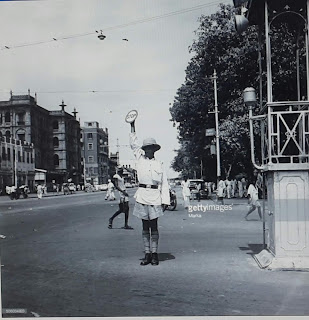
   A picture of China Bazaar Road in early 1950s with the old style policeman standing near his  sunshade umbrella cabin. In the far end National Insurance building  and YMCA building can be seen.  Road seems to be very quiet and rush hour traffic is not there.

Lodi Garden, Delhi

https://youtu.be/IKyd5F_AFxI

Kapaliswar Temple photo Video

https://youtu.be/eDBOiuC--TY

Ther Festival 1969

Image
Glimpses of Ther Festival 1969 of Kapaliswar Temple, Madras

Spencer junction 1936

Image
Spencers junction  in Madras in the year 1936. The Cupola like structure was there upto early 50s i suppose.  Neil statue can be seen by the side of the structure. Perhaps it was removed after Congress govt came to power in 1937. This is a view from Club house road.

Brahmotsavam Kapali Temple 1932

Image
Glimpses of Kapaliswar Temple annual Brahmotsavam 87 years ago in the year 1932. Pic: BFI

RBI level crossing

Image
A view of the second and third light house of Madras from the level crossing of the suburban line near the present  RBI subway. The level crossing used to be opened for the north bound traffic. The RBI subway was opened in 1965 perhaps the oldest subway of Madras.  It has come in some Hindi movies of 1960s. Pic : alamy

Chepauk Palace

Image
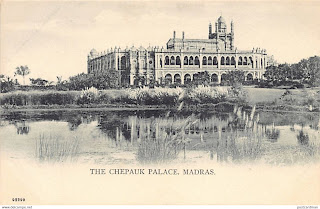
A different photograph of Chepauk Palace. Where was this water body situated. Definitely not on the East. Looks like on the North side where the centenary auditorium is situated now.  Any different opinions.

Government House, Madras

Image
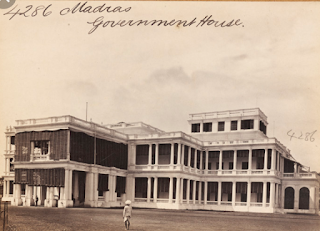
Government House Madras        After the rendition of Madras back to the British in 1749 the British wanted to  have a suitable Garden House away from Fort St. George for  the Governor.  In August 1753 the council under the Presidentship of Thomas Saunders passed a resolution for acquiring a suitable house from Mrs Lewis de Madeiros .  The identified  house was on the road to St.Thome after the Triplicane bridge costing 3500 pagodas.        A survey was ordered which found the house worth the amount. In November 1753 a bill to the effect for 3500 pagodas was placed before the council of Fort St. George and passed and the house acquired.  From then on it was the Garden House of the Governors of Fort St.George  till 1823 when it was moved to Guindy.

Marine Villa

Image
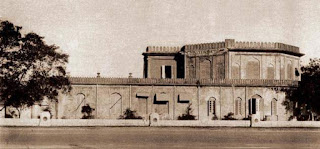
A handsome picture of Marine villa which was inside the chepauk palace compond. It was the bathing pavilion of Nawab Mohammed Ali Wallajah constructed in late 18th century. It also used to be called "Nabob's Octagon". Lord Clive stayed here when he was the Governor of Madras (1798-1803) when the Governor General Wellesley stayed in madras supervising the Mysore War in 1799.       Later on it was handed over the Madras University who demolished it in 1930 to build the University Library.  The place where the Senate house and Madras University buildings are now situated was saluting  grounds of the Chepauk palace where cannons used to give a gun salute whenever any important dignitary visits the Nawab.

Poonamalle High Road

Image
       Poonamalle High Road from the junction of Waltax Road. This  road was developed in the middle of 18th century as a military road leading to Arcot via  Poonamalle,  Sriperumbudur and Wallajapet to  Arcot.  Until early 19th century  there was a Land  custom office near St . Andrew Church  junction.  The Andrew  Church came up in 1821. The  Egmore redoubt was also there behind  the  Egmore railway  terminus. Poonamalle was also a military  outpost  for rest and recuperation of East India  Company soldiers.   This  road was the  one  taken by Hyder Ali in 1768 when  he almost reached the gates of  Madras.         In the  picture the Ramaswamy  Mudaliar  Choultry and Siddique Sarai along with the steeple of St Andrews Kirk can be seen.

Mount Road during Monsoon

Image
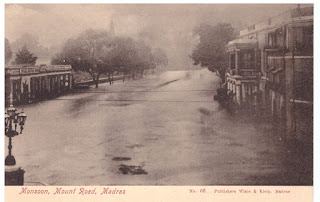
Mount Road during a monsoon day in early  1900s. It should be Bata junction  since the steeple of Christchurch adjacent to Cosmopolitan Club can be seen at the far end.