Posts

Government House, Madras
Image
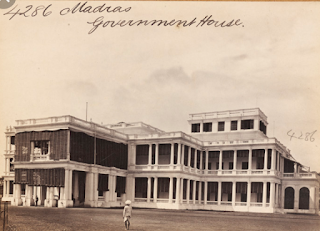
Government House Madras        After the rendition of Madras back to the British in 1749 the British wanted to  have a suitable Garden House away from Fort St. George for  the Governor.  In August 1753 the council under the Presidentship of Thomas Saunders passed a resolution for acquiring a suitable house from Mrs Lewis de Madeiros .  The identified  house was on the road to St.Thome after the Triplicane bridge costing 3500 pagodas.        A survey was ordered which found the house worth the amount. In November 1753 a bill to the effect for 3500 pagodas was placed before the council of Fort St. George and passed and the house acquired.  From then on it was the Garden House of the Governors of Fort St.George  till 1823 when it was moved to Guindy.
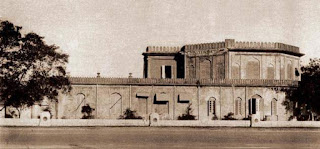
Marine Villa

Image
A handsome picture of Marine villa which was inside the chepauk palace compond. It was the bathing pavilion of Nawab Mohammed Ali Wallajah constructed in late 18th century. It also used to be called "Nabob's Octagon". Lord Clive stayed here when he was the Governor of Madras (1798-1803) when the Governor General Wellesley stayed in madras supervising the Mysore War in 1799.       Later on it was handed over the Madras University who demolished it in 1930 to build the University Library.  The place where the Senate house and Madras University buildings are now situated was saluting  grounds of the Chepauk palace where cannons used to give a gun salute whenever any important dignitary visits the Nawab.

Poonamalle High Road

Image
       Poonamalle High Road from the junction of Waltax Road. This  road was developed in the middle of 18th century as a military road leading to Arcot via  Poonamalle,  Sriperumbudur and Wallajapet to  Arcot.  Until early 19th century  there was a Land  custom office near St . Andrew Church  junction.  The Andrew  Church came up in 1821. The  Egmore redoubt was also there behind  the  Egmore railway  terminus. Poonamalle was also a military  outpost  for rest and recuperation of East India  Company soldiers.   This  road was the  one  taken by Hyder Ali in 1768 when  he almost reached the gates of  Madras.         In the  picture the Ramaswamy  Mudaliar  Choultry and Siddique Sarai along with the steeple of St Andrews Kirk can be seen.

Mount Road during Monsoon

Image
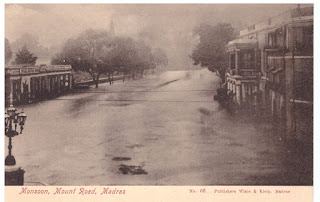
Mount Road during a monsoon day in early  1900s. It should be Bata junction  since the steeple of Christchurch adjacent to Cosmopolitan Club can be seen at the far end.

Cosmopolitan Club 1873

Image
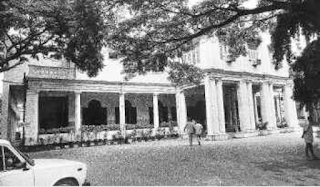
Cosmopolitan Club  1873        This  Club was started in the year 1873 as a gathering place for  high and mighty Indians of the City of  Madras with the English.  Intially  it had its premises at Moors Road, (Garden)Nungambakkam and shifted to the present place at Mount Road in 1882.         The  Office bearers of the  Club in 1881 below shows a mix of Royalty the  Maharaja of Travancore and Prince of Arcor being patrons, English men the President and Vice President  and Miller of Christian College, George Town along with the  Who's who  of Madras of 1880s including  Justice  Muthuswamy Iyer, P.Vijayaranga  Moodelliar of Thiruneermalai  Temple  Dharmakarta Clan, P.Venkatachalam Chetty , Bashyam Iyengar and  W.S.Venkataramanjulu  Naidu.            It became only  Indian Club in the  last decade of 19th ce...

Supreme court of Madras

Image
The set up of the Supreme Court of Madras in the  year 1812 when Sir Thomas Strange was the Chief Justice.  One native Ragunadum Moodelliar is working as Gen too and Malabar interpreter  and a Muslim  Mahamud Tippao is Persian and Hindoostani intrepreter. The  Supreme  Court of  Madras functioned from  Ben tick building from  1817 to  1862 when  High Court was established.

Edward Francis Elliott, Superintendent of Police, Madras

Image
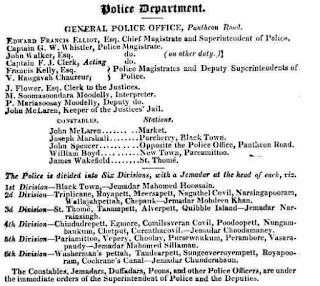
The longest Police Chief  of Madras Edward  Francis  Elliott         The  Police set  up in Madras around  1840s.  Edward  Francis Elliott was the Superintendent of Police, Madras  for  a long period of nearly  22 years. He took charge on 14th February  1834 and was holding the post up to  15th April 1856.          He was the  son of  Hugh Elliott who was the  Governor of  Madras  from  1814-1820. He was  Chief  Magistrate,  Chief  Judge of the Court of Requests  (Later Court of Small Causes)  and Superintendent of Police. His Police force retained the old posts of Jamedar,  Darogah,  Daffadar and Peons.          He was one of successful Police Chief of Madras  whose tenure was spoken in high esteem by the people of Madras for many years after he demitted office.  He...